
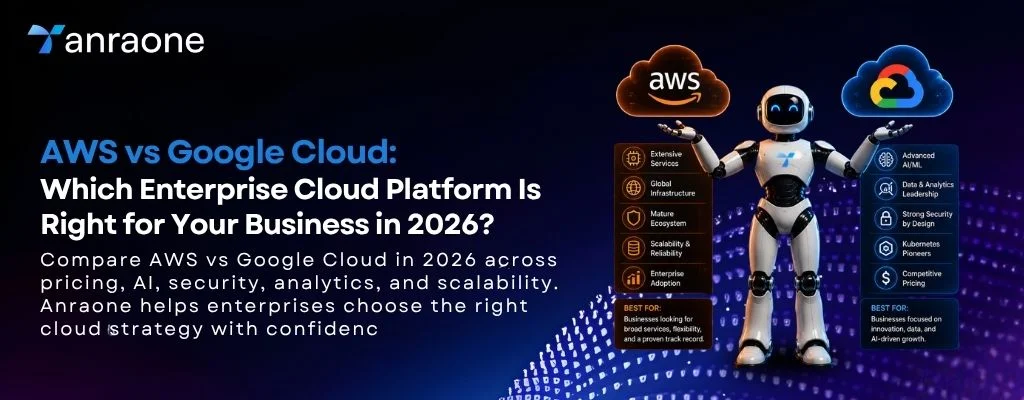
Compare AWS vs Google Cloud in 2026 across pricing, AI, security, analytics, and scalability. Anraone helps enterprises choose the right cloud strategy with confidence.
Choosing between AWS vs Google Cloud is a major decision for enterprises planning to build, migrate, or scale applications. The choice can affect infrastructure costs, security, performance, hiring, scalability, and long-term technology strategy.
AWS has a broad service ecosystem and strong enterprise adoption. Google Cloud is particularly strong in data analytics, AI, machine learning, and Kubernetes.
So, which cloud platform is better for your business?
The answer depends on your workloads, budget, existing technology stack, and future goals.
AWS vs Google Cloud: Quick Comparison
| Factor | AWS | Google Cloud |
|---|---|---|
| Service ecosystem | Very broad | Broad |
| Enterprise adoption | Very strong | Strong |
| AI and ML | Strong | Very strong |
| Data analytics | Strong | Very strong |
| Kubernetes | Strong | Very strong |
| Virtual machines | Amazon EC2 | Compute Engine |
| Object storage | Amazon S3 | Cloud Storage |
| Serverless | AWS Lambda | Cloud Run |
| Data warehouse | Amazon Redshift | BigQuery |
| ML platform | Amazon SageMaker | Vertex AI |
Both platforms can support startups, growing businesses, and large enterprise environments.
What Are AWS and Google Cloud?
Amazon Web Services (AWS) is Amazon's cloud platform, offering services for computing, storage, databases, networking, security, analytics, containers, AI, and serverless applications.
Google Cloud (GCP) is Google's cloud platform. It provides similar infrastructure and platform services, with particular strengths in data, AI, machine learning, Kubernetes, and cloud-native development.
Some comparable services include:
- Amazon EC2 → Google Compute Engine
- Amazon S3 → Google Cloud Storage
- AWS Lambda → Cloud Run
- Amazon Redshift → BigQuery
- Amazon SageMaker → Vertex AI
- Amazon EKS → Google Kubernetes Engine
Although these services solve similar problems, their pricing, features, integrations, and management models differ.
AWS vs Google Cloud for Enterprise
For large organizations, the decision involves more than comparing individual cloud services.
AWS for Enterprise
AWS can be a strong choice when an organization needs:
- A large range of cloud services
- Mature enterprise infrastructure
- Broad compliance support
- A large technology partner ecosystem
- Access to a large pool of AWS professionals
- Support for complex and diverse workloads
AWS is often attractive to enterprises that want to keep many infrastructure and application services within one ecosystem.
Google Cloud for Enterprise
Google Cloud can be a strong option for organizations focused on:
- Artificial intelligence
- Machine learning
- Data analytics
- Kubernetes
- Cloud-native applications
- Large-scale data processing
Businesses with data-heavy or AI-focused strategies may find Google Cloud particularly suitable.
AWS vs Google Cloud Pricing
There is no universal answer to which provider is cheaper.
AWS vs Google Cloud pricing depends on your architecture, region, usage, storage, networking, databases, and discount options.
AWS provides pricing options such as:
- On-Demand pricing
- Savings Plans
- Reserved Instances
- Spot Instances
Google Cloud provides:
- On-Demand pricing
- Committed-use discounts
- Cost-management tools
- Cloud Billing
AWS vs Google Cloud Cost: Which Is Cheaper?
Comparing the price of one virtual machine does not give you the complete picture.
Enterprise cloud costs can include:
- Compute
- Storage
- Databases
- Data transfer
- Networking
- Backups
- Monitoring
- Support
For an accurate AWS vs Google Cloud cost comparison, calculate the total cost of ownership (TCO) for your actual workload.
AWS vs Google Cloud Market Share
AWS has a larger share of the global cloud infrastructure market than Google Cloud.
Its large customer base, broad service portfolio, partner ecosystem, and long history in cloud computing contribute to its strong market position.
Google Cloud has also built a strong position, particularly in AI, analytics, machine learning, and cloud-native technologies.
AWS vs Google Cloud market share is useful when evaluating ecosystem size, but market share should not be the only factor in an enterprise cloud decision.
AWS vs Google Cloud for AI
AI is now an important part of enterprise cloud strategy.
Google Cloud offers services including:
- Vertex AI
- Tensor Processing Units (TPUs)
- BigQuery ML
- Generative AI capabilities
AWS offers:
- Amazon Bedrock
- Amazon SageMaker
- Machine learning services
- AI infrastructure
Google Cloud can be particularly attractive for organizations building AI and data-intensive applications.
AWS can be a practical choice for enterprises that already run their applications and data on AWS and want to add AI capabilities without moving to another platform.
AWS vs Google Cloud for Data Analytics
Google Cloud has a strong reputation in data analytics, largely because of BigQuery.
BigQuery is a serverless data warehouse designed for large-scale analytics. Google Cloud also provides services such as Dataflow, Dataproc, and Looker.
AWS offers an established analytics ecosystem that includes:
- Amazon Redshift
- Amazon Athena
- Amazon Kinesis
- AWS Glue
For analytics-heavy organizations, Google Cloud can be an attractive option. However, enterprises already invested in AWS data services may benefit from staying within the AWS ecosystem.
AWS vs Google Cloud Security
Both platforms provide extensive security features for enterprise environments.
AWS supports:
- Identity and access management
- Encryption
- Network security
- Threat detection
- Compliance
Google Cloud provides:
- Identity and access management
- Encryption
- Security monitoring
- Threat detection
- Infrastructure protection
- Compliance capabilities
The security of a cloud environment depends not only on the provider but also on how the infrastructure is configured and managed.
Enterprises should evaluate the security controls, compliance requirements, and data residency rules specific to their industry.
AWS vs Google Cloud Certification
Both platforms have established certification programs for cloud professionals.
AWS certifications cover areas such as architecture, development, security, operations, and machine learning.
Google Cloud certifications include cloud architecture, engineering, data engineering, machine learning, and security.
For businesses, certifications can help demonstrate technical expertise. For professionals, the better certification is usually the one that matches the technologies and roles they want to work with.
AWS vs Google Cloud Free Tier
Both AWS and Google Cloud offer free usage options for selected services.
These can be useful for:
- Learning
- Testing
- Prototyping
- Small applications
- Certification practice
Free-tier limits and eligibility can change, so check the providers' current pricing information before using free services for business workloads.
AWS vs Google Cloud for Web Hosting
Both platforms can host websites, APIs, SaaS applications, and enterprise systems.
AWS services commonly used for web applications include:
- Amazon EC2
- Amazon S3
- Amazon CloudFront
- AWS Lambda
Google Cloud provides:
- Compute Engine
- Cloud Storage
- Cloud CDN
- Cloud Run
For a simple website, traditional hosting may be easier and less expensive.
For enterprise applications that require scalable infrastructure, databases, APIs, security, and global delivery, both AWS and Google Cloud are capable platforms.
AWS vs Google Cloud for Startups
Startups usually look for a balance of cost, speed, scalability, and simplicity.
AWS may be suitable when:
- The team already knows AWS
- A wide range of services is required
- The application is expected to scale quickly
- Hiring AWS talent is important
Google Cloud may be suitable when:
- AI is central to the product
- Data analytics is important
- Kubernetes is part of the architecture
- The team already has Google Cloud experience
For startups, the best cloud is often the platform the team can manage efficiently.
AWS vs Google Cloud vs Azure
Enterprises should also consider Azure when comparing the major cloud providers.
| Factor | AWS | Google Cloud | Azure |
|---|---|---|---|
| Service range | Very broad | Broad | Very broad |
| Enterprise adoption | Very strong | Strong | Very strong |
| AI | Strong | Very strong | Strong |
| Analytics | Strong | Very strong | Strong |
| Kubernetes | Strong | Very strong | Strong |
| Microsoft integration | Moderate | Limited | Very strong |
AWS is a strong all-round option for complex enterprise requirements.
Google Cloud is particularly attractive for AI, analytics, Kubernetes, and cloud-native workloads.
Azure can be a natural choice for organizations heavily invested in Microsoft technologies.
How to Choose Between AWS and Google Cloud
Before selecting a platform, evaluate these five areas:
1. Workloads
Understand whether your business needs compute, databases, APIs, analytics, AI, or a combination of services.
2. Total Cost
Compare the complete infrastructure cost rather than looking at a single service.
3. Existing Skills
Your team's AWS or Google Cloud experience can reduce training, hiring, and migration costs.
4. Security and Compliance
Check the certifications, security controls, and data residency requirements relevant to your industry.
5. Future Growth
Consider expected increases in users, data, international operations, AI adoption, and application complexity.
Frequently Asked Questions
Is GCP better than AWS?
Not for every business. Google Cloud has strong capabilities in AI, analytics, data, and Kubernetes, while AWS offers a broader cloud ecosystem and strong enterprise infrastructure.
Is AWS cheaper than Google Cloud?
Not necessarily. AWS vs Google Cloud costs depend on workload, region, architecture, storage, networking, and available discounts.
Which is better for AI, AWS or Google Cloud?
Both are strong options. Google Cloud has notable strengths in AI, machine learning, and analytics, while AWS provides powerful AI services and strong integration with existing AWS environments.
Which has a larger market share, AWS or Google Cloud?
AWS currently has a larger share of the global cloud infrastructure market than Google Cloud. However, market share alone does not determine the best provider for an individual business.
Which is easier to learn, GCP or AWS?
Both require hands-on practice. AWS has a large learning ecosystem, while Google Cloud is widely used for data, AI, and Kubernetes workloads. Your existing technical background can make one easier than the other.
AWS vs Google Cloud vs Azure: Which should you choose?
Choose AWS for broad enterprise capabilities, Google Cloud for AI and data-focused workloads, and Azure when Microsoft technologies are central to your business.
Final Verdict
The AWS vs Google Cloud decision should be based on your business requirements rather than market popularity alone.
AWS is a strong choice for enterprises that need a broad service ecosystem, mature infrastructure, and extensive technology integrations.
Google Cloud is especially compelling for organizations focused on AI, machine learning, analytics, Kubernetes, and cloud-native applications.
Before making the final decision, compare your workloads, calculate your expected costs, review security requirements, and consider your team's existing skills.
The right cloud platform is the one that provides the best balance of cost, performance, security, scalability, and operational simplicity for your business.