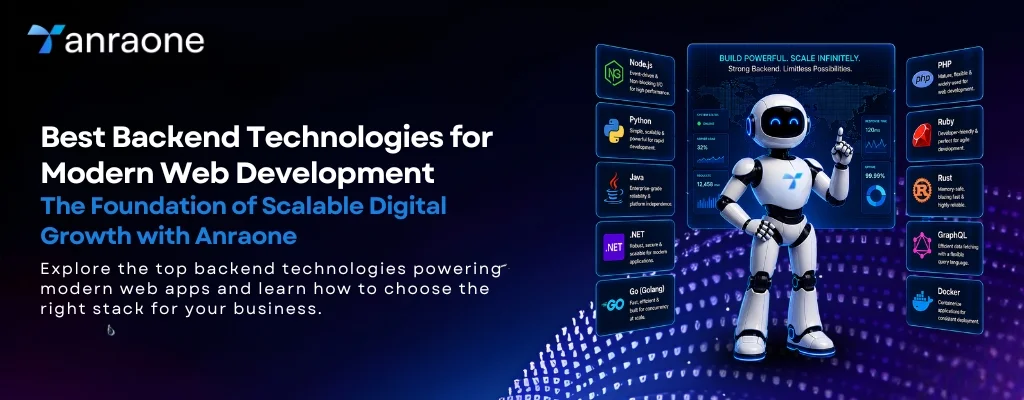
Explore the top backend technologies powering modern web apps and learn how to choose the right stack for your business.
Every web application has something invisible holding it together. Users never see the database layer, API pipeline or authentication system behind each click. They notice when one is badly built: the page hangs or the login fails.
The backend sets the ceiling on traffic, on how safely you hold customer data, and on what the next feature costs to add.
The right backend stack does more than support the application. It raises performance, scalability, security and operational efficiency.
Why Backend Architecture Directly Shapes Business Performance
An outdated backend costs you in predictable ways: slow pages, security holes, integrations that break, and eventually a full rebuild.
- Sub-Second Response Times: Fast pages keep visitors on the site and score better on Google's Core Web Vitals.
- Elastic Scalability: Absorb a traffic spike without slowing down or paying for idle servers afterwards.
- Built-In Security: Protection against SQL injection, XSS attacks and data breaches built into the framework, not patched on later.
- Unified Connectivity: Clean APIs between applications, CRMs, ERPs, cloud services and AI systems, so adding one is not a rewrite.
The Dominant Backend Technologies in 2026
PHP & Laravel
Laravel is still one of the most reliable choices for an application with logins and billing. MVC, authentication, queues and an ORM come in the box.
Best For: SaaS platforms, ERP systems, CRM applications, subscription-based platforms, and enterprise portals.
Node.js
Node.js runs a non-blocking event loop, so one process holds many open connections at once. That is why it wins for real-time work.
Best For: Real-time dashboards, collaborative tools, microservices, chat applications, and API-intensive platforms.
Python (Django / FastAPI)
Python owns AI and machine learning work because the data science and automation libraries live there.
Best For: Predictive analytics, AI-driven applications, automated workflows, and data-intensive platforms.
Java & .NET
Java and .NET are the usual choice for large financial and healthcare systems. Both are built for large distributed systems and for industries where compliance rules are strict.
Best For: Financial platforms, healthcare systems, industrial operations, and enterprise infrastructures.
Choosing the Right Stack for Your Use Case
| Framework | Primary Use Case | Core Business Benefit |
|---|---|---|
| PHP / Laravel | CRM, ERP, SaaS Platforms | Rapid deployment and strong native security |
| Node.js | Real-time Applications & APIs | High concurrent performance and unified JS stack |
| Python | Machine Learning & Big Data | Advanced AI integration and analytics capability |
| PostgreSQL / MySQL | Structured Transaction Systems | High data integrity and ACID compliance |
| MongoDB | Unstructured Cloud-Native Data | Flexible document storage and scalability |
The Technologies Shaping Backend Development Going Forward
- Serverless Functions: On-demand backend execution with automatic scaling and reduced infrastructure costs.
- Zero Trust API Security: Every request is verified, whether it comes from the public internet or a service inside your network.
- GraphQL Over REST: The frontend asks for exactly the fields it needs in one query, not several REST calls.
- AI-Native Backend Integration: Machine learning, NLP and predictive analytics designed into the data model from the start, not retrofitted later.
Auditing Your Backend Strategy Before You Build
- Is your framework modular enough to scale with growing traffic and complexity?
- Does your architecture enforce end-to-end encryption and API verification?
- Can your backend integrate with AI and machine learning systems without future rewrites?
- Is your infrastructure optimized for Google's Core Web Vitals standards?
- Do you have a structured maintenance and monitoring strategy post-launch?
The Bottom Line
Frontend design attracts users. The backend decides whether they stay: sub-second pages, a login that resists injection, a site that stays up through a traffic spike.
Match the stack to the product: Laravel for SaaS and ERP, Node.js for real-time, Python for machine learning, Java or .NET where a regulator is. Get it wrong and you pay for the rebuild.
Build Your Backend Infrastructure the Right Way
Talk to Anraone before you commit to a stack. Anraone designs and builds secure, scalable backends and can say which stack fits your product.
Get Free Consultation